
Crossing the Line: Why Global Sport Comes With Global Visa Challenges

The 2026 FIFA World Cup has already delivered memorable moments on the field, but it has also exposed the immigration realities behind major sporting events. From visa costs to cross-border access, Vozinha’s story shows how global tournaments are shaped by much more than sport alone.
Cape Verde goalkeeper Vozinha’s emotional response after his side’s draw with Spain was one of the early human stories of the World Cup. The Cape Verde team, playing at its first World Cup, held Spain to a 0-0 draw. Vozinha (full name Josimar José Évora Dias), playing at 40 years old, was able to save 7 attempted shots on goal by Spain, and had produced the performance of a lifetime.
As reported in the Guardian:
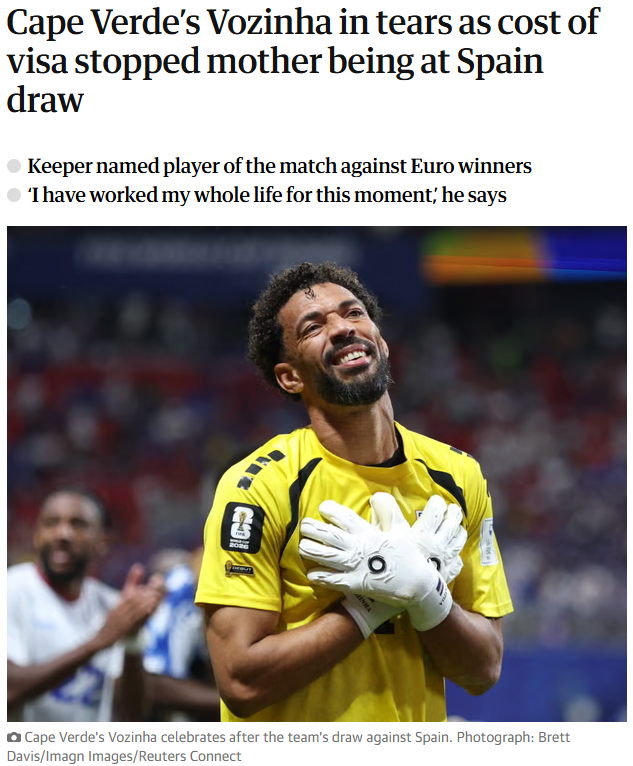
Off the field, there was an even deeper story. His mother was unable to be there because of the cost and complexity of getting into the United States. Players from certain countries needed to pay a US$15,000 bond to enter the country. For anyone watching the tournament through an immigration lens, it was also a reminder that major sporting events are never just about stadiums, fixtures and broadcast rights - they are also large-scale migration projects.
The United States is one of the world’s most important destinations for major events, business and tourism, but it is also one of the most challenging countries to enter. Visa applications can involve interviews, documentation, screening, long lead times and significant cost. For some travellers, additional requirements can apply, including visa bonds.
The 2026 FIFA World Cup highlights this challenge well. The tournament features 48 teams and 1,248 players. Once coaches, medical teams, performance staff, officials, media, security, families and fans are added, the number of people moving across borders becomes enormous.
This also raises an interesting question. Are these people travelling on “sports visas”, “work visas” or something else? The answer is not always straightforward.
A footballer at the World Cup is usually a paid athlete because they are on salary (under contract) for a professional team during the year. But this salary is not paid by their host country, therefore they are not employes of the country.
Their national association may pay allowances, match fees or performance bonuses but they are not an employee. FIFA prize money is paid to participating member associations, which then decide how that money is shared with players and staff. FIFA also compensates clubs for releasing players through its Club Benefits Programme.
In other words, a World Cup player can be a highly paid professional without being a conventional foreign worker in the United States while they are visiting. This makes the visa process more complex.
The situation is somewhat clearer for support staff. Coaches, physios, analysts, doctors, media staff and team administrators may all be paid employees from their national sporting association. However, they may still be entering temporarily as accredited members of an international delegation rather than taking up temporary employment in the host country.
That is why major-event immigration often sits in a grey area between sport, temporary activity, business travel and work. The key question is not simply whether someone is paid. It is who is paying them, what they are doing, how long they are staying, whether they are employed locally, and whether there is a special event framework in place.
This will matter for Australia as Brisbane 2032 approaches. The Olympic Games are expected to bring around 10,500 athletes to Australia. The Paralympic Games will add a further 4,350 athletes. There may be as many as 5,000 accredited coaches and support personnel, along with volunteers, officials, media, spectators and other Games stakeholders.
Olympic athletes also sit in a different category from people like professional footballers. A number of Olympians are fully professional, essentially working as self-employed contractors. But most athletes have “day job” back home - and while they may also receive government support, grants, sponsorships or medal bonuses throughout their Olympic careers, the income would likely not be high enough to classify as their profession for the purposes of a visa application (if for example, their goal was to migrate long term).
Popular sports such as cycling attract plenty of sponsors and professionals, while competitors in more niche sports will need to fundraise their way to national tournaments and to progress to international tournaments. But no matter how deep the financial resources of a competitor may be, they will all need a lawful pathway to enter Australia, train, compete and be supported by coaches and staff for Brisbane 2032.
Major tournaments can often expose harder immigration realities. In some cases, athletes or delegation members from countries facing poverty, instability or conflict have used international competitions as a pathway to remain in the host country, including by overstaying visas or seeking asylum. Some may have genuine protection claims, while others may simply see a rare opportunity to build a safer or more stable life. For host countries, this is another reason why major-event immigration planning needs to consider both compliance and compassion.
Australia already has temporary activity visa settings that can apply to sporting activities, including playing, coaching, instructing or adjudicating. The Temporary Activity Visa (Subclass 408) - Sporting Activities stream is designed for elite athletes, coaches, instructors, and adjudicators to live and work in Australia for up to 2 years.
Brisbane 2032 will be significantly larger and more complex immigration project to manage than the Formula One, Australian Open and the Commonwealth Games. It will require a coordinated approach for athletes, team officials, support staff, families, volunteers, spectators and commercial partners, including the media and broadcasting staff that will travel to the games.
Hosting a major global sporting event is not just about building the venues and selling the tickets. It is also about making sure the people who are meant to be part of the moment can actually get there in time to enjoy the opportunity of a lifetime.
Please note: The information on this page is provided for general information purposes only and does not constitute legal advice. It is not intended to be comprehensive or to apply to any specific circumstances. You should seek independent legal advice before acting on any information contained on this page.
Design by: Cabria Design. Site by: Flux Creative